

What paperwork do I need to complete?
Important details for completing your certification documentation.
- Certification
Key terms
Paperwork must be done when the electrical work is completed.
The type of paperwork and other things that need to be completed depends on the work. Here is what’s meant by a few key terms:
The risk category of the prescribed electrical work (PEW)
- Low includes replacements and repairs on existing installations
- High includes Mains Work, PV Solar, along with other special installations such as medical, hazardous etc
- General includes all the other work such as installation, sub-circuits and sub-boards.
Final connection of installation to a power supply
'Connection' is the final bit of PEW that, when completed, will allow electricity to flow into the installation.
For example, it’s the final act in hooking in the mains, so that when a person inserts the supply fuse carrier, it powers up the MEN Board. Inserting the fuse is not PEW.
Issued
This is when the person responsible completes the certificate and gives a copy to the relevant parties.
Certification requirements for photovoltaic (PV) systems
Different PV systems have specific requirements, for example.
Where there is a mains inverter within the PV system, which is a low voltage mains parallel system that is connected to the national grid, the inverter must be installed to comply with the standards AS/NZS 3000 and AS/NZS 4777.1. This work is categorised as high-risk PEW which will require certification and a record of inspection (ROI).
To learn more about certification, WorkSafe have provided guidance.
PV certification compliance(external link) — WorkSafe
Quick guide overview
Risk categories determine certification requirements.
| Certification requirement | Low-risk work | General work | High-risk work |
|---|---|---|---|
| Certificate of Compliance (CoC) | Optional | Required | Required |
| Record of Inspection (RoI) | Not required | Not required | Required |
| Electrical Safety Certificate (ESC) | Required | Required | Required |
| Entry on Electricity and Gas High-risk Database (by electrical inspector) | Not required | Not required | Required |
Basic information
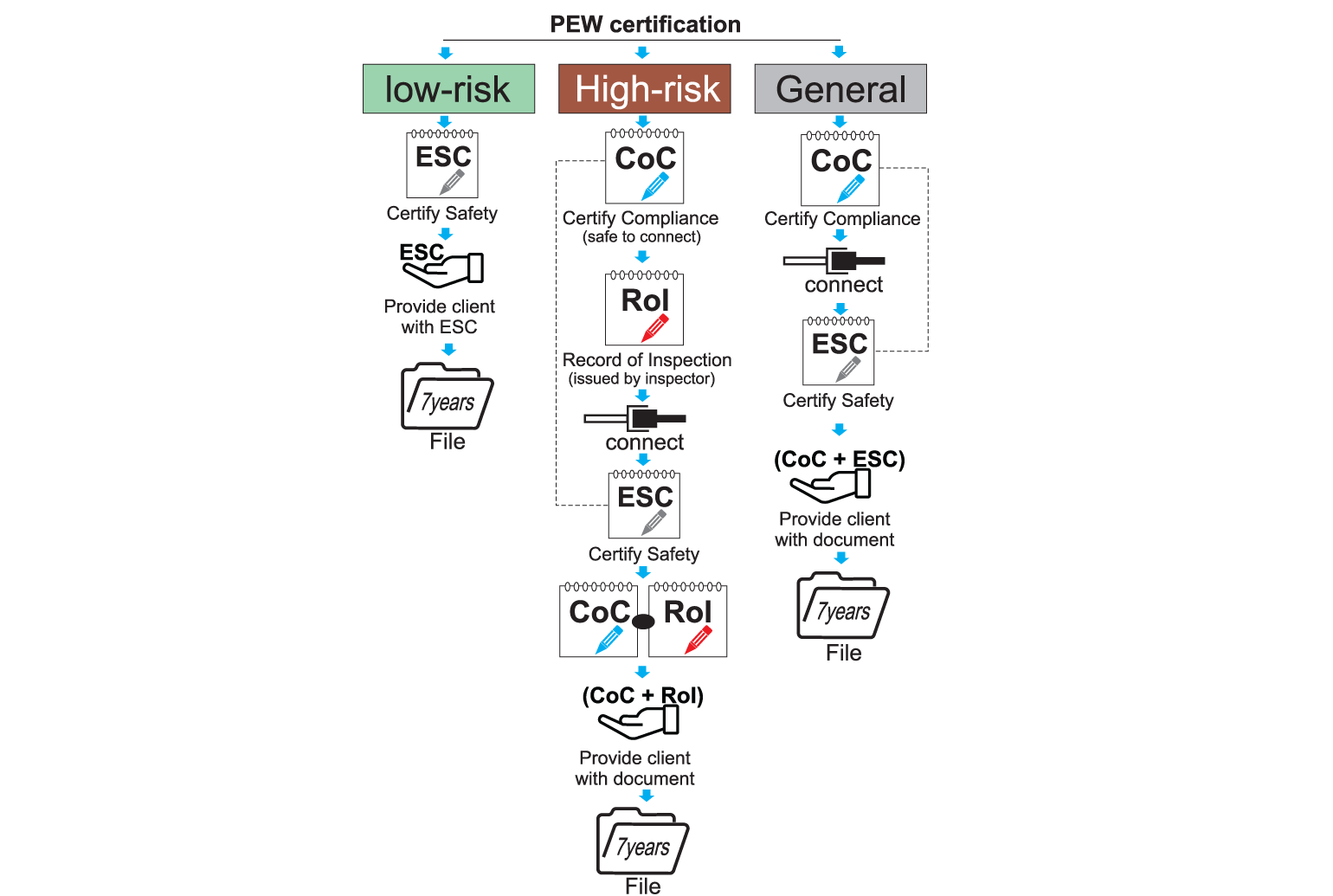
This handy quick guide should give you a good idea of what’s needed based on the type of work you’re doing:
| Title | Content |
|---|---|
| Low-risk |
|
| High-risk |
|
| General |
|
Visual guide
More details
High risk work
Inspection
- All high-risk work requires independent inspection by a licensed electrical inspector who is competent in the high-risk PEW they are inspecting.
- The inspector must be independent and not associated in any way with the work they are inspecting.
- The inspector must issue a Record of Inspection (RoI) and lodge this on the high-risk Energy Safety database:
Electricity and Gas High-risk Database(external link) — WorkSafe - No high-risk PEW work is legally complete until the COC and RoI is issued.
- For high-risk work, the RoI issued by the Electrical Inspector must have the relevant CoC attached.
Low risk work
Replacement or repair work example, the replacement of a light switch or power outlet or Residual Current Device (RCD) needs to be verified it is electrically safe. This done by issuing an Electrical Safety Certificate (ESC).
General risk PEW
This is generally installation work (new additions, alterations, rewires, new and extended circuits) but is not high risk or low risk work.
General PEW requires you to issue a Certificate of Compliance (CoC) and ESC.
Final connection of installation to power supply
The person doing that final connection is responsible for making sure that the installation they are connecting to is electrically safe. They are responsible for issuing the ESC.
If that person has not carried out that work on the installation then they have to verify it is safe to connect.
They must sight the CoC and RoI. They can rely in good faith on these documents and only then complete that final connection. It is recommended that person retain copies of these certificates.
Approved certification documentation
You’re allowed to make certification documentation in lots of different formats, such as paper and digital/electronic. A design check list is available from the Worksafe website.
Electrical certification and record of inspection templates(external link) — Worksafe
You can also get documents that are already made from:
- most electrical suppliers/wholesalers
- our forms page
- Providers of online and cloud based electrical compliance and certification programmes.
The Certificate of Compliance (CoC) and the Electrical Safety Certificate (ESC) are often combined. The 2 documents have different purposes and in all cases the ESC is the final part of the document to be completed by the person who did the connection or the work and is responsible for that work.
Choosing and using the right document
There are lots of certification forms and formats available, so choose a document based on the:
- frequency of PEW undertaken
- type and complexity of work most commonly undertaken, for example, domestic, commercial wiring, maintenance
- business efficiency and ease of document management
- professionalism you wish to portray of your business
- ease of document storage for the required 7 years.
Certification documents
You must complete your certification documents fully and correctly.
Description of work
When completing ESC, CoC or RoI, you need to include details of the work undertaken – be sure to record all the work that you were responsible for, the range of dates the work was carried out, and any supervised people involved with the work.
Feel free to attach any additional pages, information, drawings and documents to a CoC or RoI to provide the necessary detail.
Testing
It’s best trade practice to record all your test results. This provides additional proof and further verification of electrical safety.
What type of work
Take care to indicate what level of risk the work is and the standard it conforms with, don’t just tick all the boxes.
Supplier Declaration of Conformity (SDoC) and manufacturers instructions
If you are relying on manufacturers’ instructions and a supplier declaration of conformity (SDoC) only tick those boxes if you supply a copy or an internet link to those items. If you don’t supply a copy or link, then don’t tick those boxes.
An example of why including SDoCs protects you
You may have done the work according to the manufacturer’s instructions and the fittings you used comply with NZ standards have an SDoC. Let’s say these fittings were from long established reliable suppliers/manufacturers with reputable brands and products. However, if you do not provide a copy or link to the SDoC or manufacturer’s instructions with the CoC then you are not specifically relying on those documents and you do not tick those boxes.
You can however always ask your supplier and they should be able to provide you with a copy or link to these documents.
If you have any doubt about the quality, safety or compliance with NZ standards of any electrical fitting, then ask to for a copy of the SDoC and manufacturers’ instructions and attach these to the CoC. This will give you protection against possible future liability associated with those fittings.
Leaving out information on a certification form
A CoC is an important legal document that confirms who was responsible for the work, that the work has been done lawfully, has been tested and all the information in the certificate is correct.
It is your responsibility to make sure this information is complete and correct otherwise the certification could be viewed as false or misleading.
Providing documents and keeping records
Issuing certification - time frames
You must issue the certification as soon as possible after you complete the installation or electrical work. You must issue it within 20 days.
Who should receive the certification documentation?
Under the Electricity (Safety) Regulations 2010, you must provide copies of your certification documents for PEW to either:
- the person or company representative who contracted the work or authorised the work to be undertaken
- the occupier or owner of the place where the installation is located, if the person who contracted for the work is not available.
If you carry out PEW on a non-consented small stand-alone dwelling ('granny flat'), you must provide copies of your certification documents to both of the above.
Granny flats exemption: Guidance and resources(external link) — Building Performance
Record keeping
Certification documents must be retained by the person who is considered the responsible person for these documents for a period of 7 years either in hard copy or electronically.
The regulations set out the people and authorities who can legally ask for these documents at any time with in the 7-year period and the responsible person must be able to provide them within 10 working days.